
Criminal Court Records in Leake County
A criminal court record is the official case file the court keeps after charges are filed against a defendant. In Leake County, felony case files sit with the Circuit Clerk, who serves as clerk of the Circuit and County Courts. The clerk receives indictments, motions, and related papers, then keeps the record of judgments and executions. The Leake County Circuit Clerk, Viktorea Pace, works from the Leake County Courthouse on Court Square in Carthage. Leake sits in the Eighth Circuit Court District with Neshoba, Newton, and Scott counties. Each Leake County case opens a numbered file that grows as the matter moves forward.
Not every criminal case starts in the same court. Misdemeanors, county ordinance violations, and DUIs are heard in Justice Court, while felonies move toward Circuit Court. A felony arrest usually begins with an initial appearance in Justice Court. From there the District Attorney takes the felony toward a grand jury and Circuit Court. City citations route instead to the Carthage Municipal Court. So one defendant can leave a trail in more than one court file. The charges themselves are detailed in the Leake County arrest and court charge records, while the broader set of filings appears across all county court records.
Courts Behind Leake County Criminal Cases
Two paths shape most Leake County criminal case files. The misdemeanor path stays in Justice Court. The felony path runs from the first appearance toward the Circuit Court. Justice Court judges hold court sessions at the jail three times each week, which protects an arrestee's right to an initial appearance within three days of arrest. That early hearing sets bond and reads the basic charge.
Felonies do not stop in Justice Court. The case moves to the District Attorney, who can present it to a grand jury. If the grand jury returns an indictment, the case is filed in Circuit Court. The Circuit Court has original jurisdiction over criminal matters not assigned elsewhere, and most cases there are heard by juries. The Circuit Clerk then keeps the full file, from indictment through sentencing and any appeal notice.
Lower courts feed the system too. State Highway Patrol and Sheriff traffic tickets, county ordinance counts, and small criminal matters live in Justice Court records. City of Carthage citations live in Municipal Court records. A single Leake County arrest can therefore produce more than one record in more than one office.
Note: A felony charge filed at the jail can later become a Circuit Court indictment, so the same defendant may appear in both a Justice Court file and a Circuit Court file.
How to Search Leake County Criminal Court Records
Online access to Leake County criminal case records runs through Mississippi Electronic Courts, the statewide case system. Leake County Circuit Court went live on MEC on August 12, 2024, with mandatory electronic filing soon after. The public side, called PAMEC, lets registered users pull dockets and case detail where the record is public. A login is required, so anonymous searching is limited.
- Open the Mississippi Electronic Courts portal and the public access PAMEC system.
- Register or sign in; case and docket access needs a PAMEC account.
- Choose the court. Leake County Circuit Court is in the Eighth Circuit Court District.
- Search by defendant name or case number, then narrow by filing date or case type.
- Open the docket to read the charges, plea, disposition, and sentence; ask the Circuit Clerk for a certified copy if you need one.
When the online path falls short, the clerk counter fills the gap. Older files, sealed documents, and certified copies often require a call, a visit, or a mailed request to the Circuit Clerk at P.O. Box 67, Carthage, MS 39051, or by phone at 601-267-8357. PAMEC does not override sealed or confidential limits, so some files show only basic status.
Stages of a Leake County Criminal Case
A Leake County criminal case moves through set steps, and each step adds entries to the record. The docket lists the date and the action for every step, so a reader can trace the case from start to finish. Some cases run for months. Others close in a single hearing with a plea.
Case flow: Charges Filed › Arraignment › Pretrial / Motions › Plea or Trial › Disposition › Sentencing
- Arraignment
- The defendant hears the charges read in open court and enters a plea. Bond and the right to counsel are addressed at this stage.
- Pretrial and Motions
- Lawyers file motions, share evidence, and argue what a jury may hear. A continuance can push hearing dates later.
- Plea or Trial
- Most cases end in a plea. Others go to a jury trial, where the state must prove guilt beyond a reasonable doubt.
- Sentencing
- After a guilty plea or a verdict, the judge imposes the sentence. That can be prison, jail, probation, fines, or restitution.
What a Leake County Criminal Court Record Shows
The Leake County case file is built from many fields, and each one tells part of the story. A felony file in Circuit Court can include the case number, parties, attorneys, judge, indictment, motions, docket entries, orders, plea, trial result, sentence, bond, fines, restitution, probation terms, and any appeal notice. The table below breaks down the core fields a reader meets first.
| Field | What It Shows |
|---|---|
| Case Number | The unique number the clerk assigns when the case opens; used to pull the full file. |
| Defendant | The person charged, with the case style naming the state as the other party. |
| Court and Judge | Which court holds the case and the judge or chancellor assigned to it. |
| Charges | The offense or offenses as filed, with the statute and severity level. |
| Bond | The amount and type of bond set, and whether the defendant posted it. |
| Plea | The defendant's formal answer to each charge, such as guilty, not guilty, or no contest. |
| Disposition | The outcome, such as dismissed, guilty, not guilty, or transferred. |
| Sentence | The punishment after conviction: incarceration, probation, fines, or restitution. |
Personal data inside a file can be redacted. Mississippi practice removes items like Social Security numbers, dates of birth, and account numbers from public copies while releasing the rest. So a public version may hold a blank or masked field where sensitive data once sat.
Who Prosecutes Leake County Criminal Cases
The District Attorney drives the felony record. Mark Duncan serves as the District Attorney for the Eighth Circuit District and prosecutes adult felony crimes across Leake, Neshoba, Newton, and Scott counties. Mississippi has 22 District Attorneys, each elected from a district for a four-year term. The office files indictments and pursues felony cases in Circuit Court, which is where the deepest criminal court records are kept. The county's District Attorney page outlines that role.
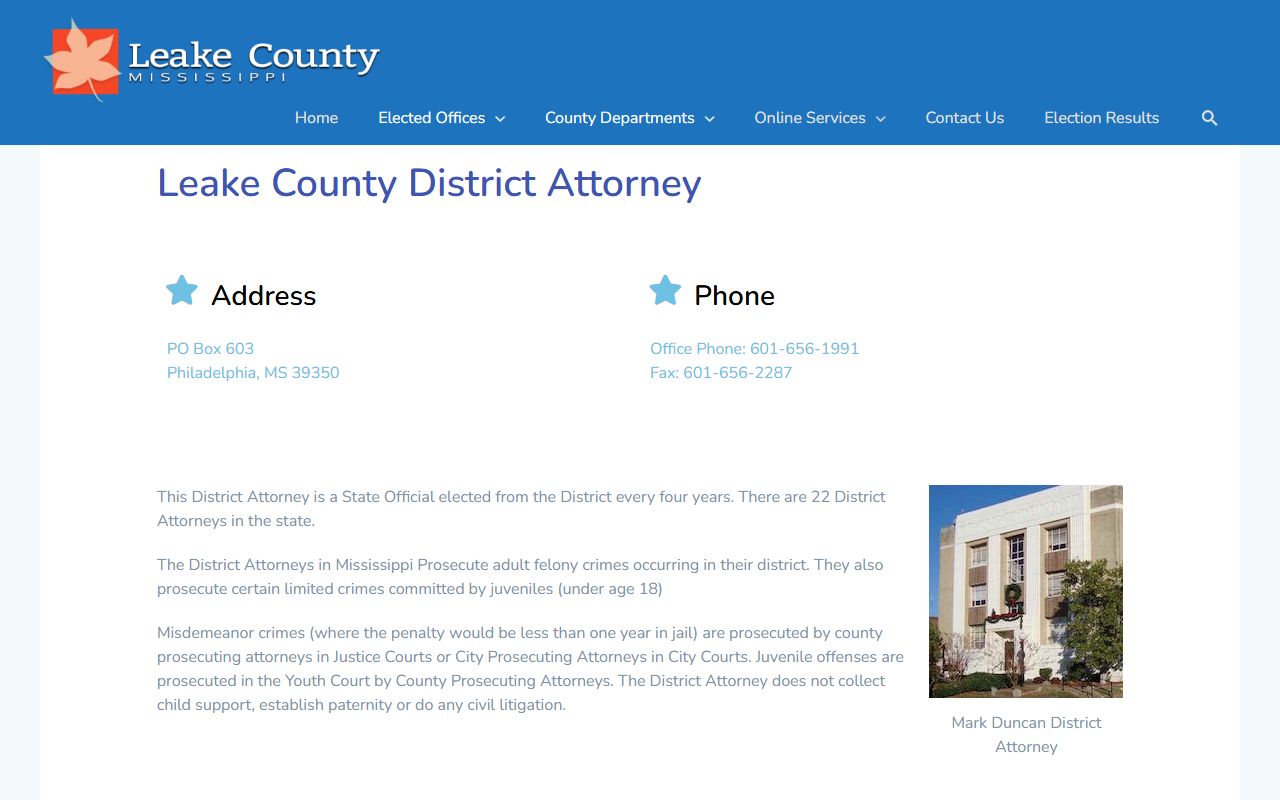
That page shows how felony prosecution feeds the Circuit Court file, since an indictment from the District Attorney is what opens many criminal court records. Misdemeanors take a different prosecutor. Carmen Wright serves as the county Prosecuting Attorney and represents the state in Justice or County Court, in criminal appeals from those courts to Circuit Court, before the grand jury, and in misdemeanor youth court matters. The Prosecuting Attorney page lists those duties.
That page helps explain why one defendant's criminal court records can sit in two places. A misdemeanor handled by the Prosecuting Attorney stays in Justice Court, while a felony handled by the District Attorney climbs to Circuit Court. Both leave a case file behind.
Charges vs. Convictions
Being charged is not the same as being convicted. A Leake County criminal court record can show charges that were dropped, dismissed, reduced, or that ended in an acquittal. A charge is only an accusation. A conviction is a finding of guilt by plea or verdict. Reading a file correctly means checking the disposition, not just the charge that opened the case.
| Charge | Conviction | |
|---|---|---|
| Stage | Accusation | Verdict or plea |
| Burden of Proof | Probable cause | Beyond reasonable doubt |
| Who Decides | Grand jury or prosecutor | Judge or jury |
| Public Record | Yes | Yes |
Note: A dropped or dismissed charge still appears in the public file unless a court later expunges it, so an open lookup can show counts that never led to a conviction.
Reading Leake County Case Dispositions
The disposition is the heart of a Leake County record. It states how each charge ended. A clear file pairs every count with its own outcome, since a case with several charges can close several ways at once. Common dispositions show up again and again in Leake County files.
- Guilty: the defendant pleaded guilty or a jury found guilt.
- Not guilty: a jury or judge acquitted the defendant.
- Dismissed: the court ended the charge without a conviction.
- Nolo contendere: a no-contest plea treated like a guilty plea for sentencing.
- Deferred or diverted: the case is held open pending a program, then dismissed if completed.
The sentence follows a conviction in a Leake County file. Read it for the term and the type. A file may list prison time with the Mississippi Department of Corrections, county jail time, probation, fines, court costs, and restitution to a victim. Some terms run at the same time, while others stack one after another. The order in the file is the controlling word.
Eighth Judicial District Drug Court
Some Leake County criminal cases close through Drug Court rather than a standard sentence. The Eighth Judicial District Drug Court was set up on December 16, 2003, and the county describes it as the first certified Drug Court in Mississippi. It serves Leake, Scott, Newton, and Neshoba counties and handles drug crimes and drug-driven crimes, including some DUI and probation violation cases. The official Drug Court page explains how the program runs.
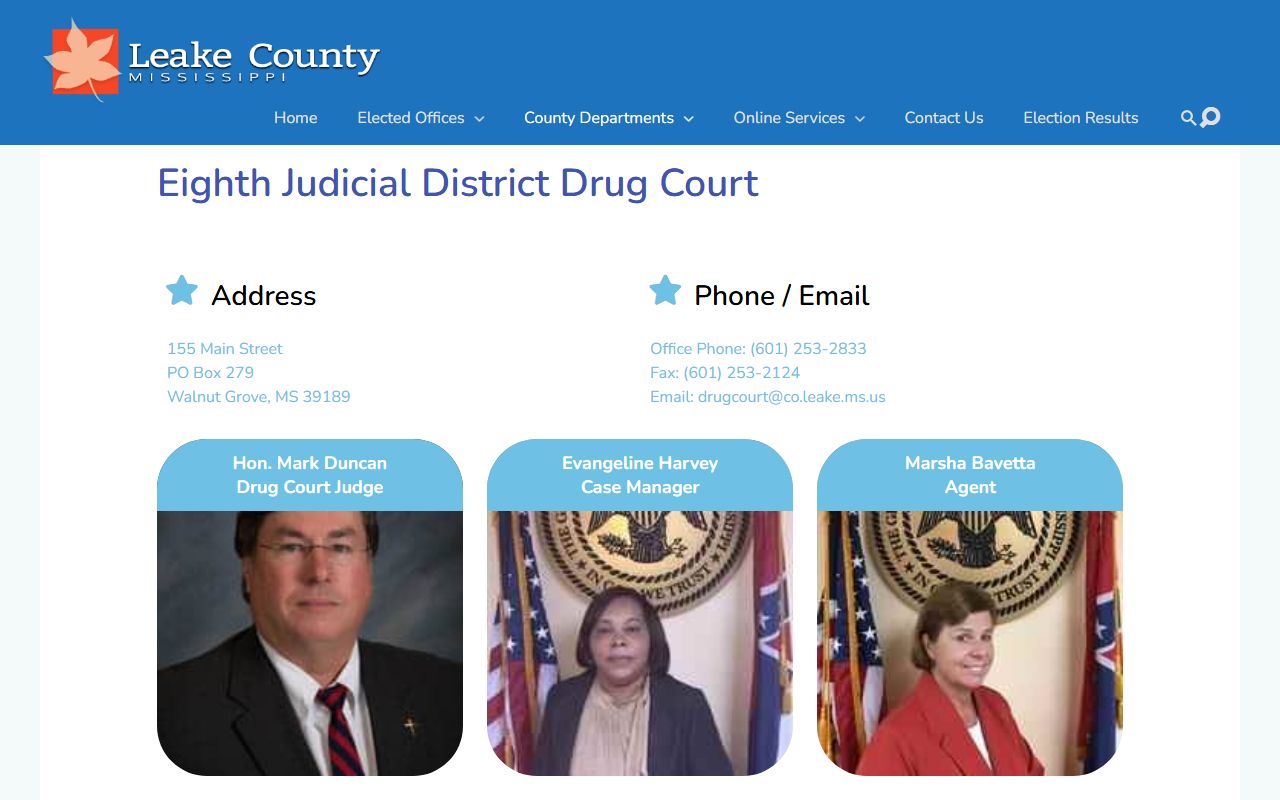
That page shows why these case files read differently. Approved participants are usually placed on probation with Drug Court for five years, with unannounced drug screens at least weekly and weekly court appearances. People who complete the program may have eligible charges expunged by the Drug Court judge, while those who fail are sentenced to the maximum term and sent to state custody. The record reflects which path the case took.
Public Access to Leake County Records
Most criminal case files in Leake County are open to the public. State policy favors inspection of public records unless another law closes them. Court records add their own rules through clerk procedures, court rules, and sealing orders. So the starting point is simple: ask the office that owns the file, which for felonies is the Circuit Clerk. The judiciary handles its own records under a written public records policy tied to state law.
Key Statutes:
Mississippi Code § 25-61-1 - sets the state policy that public records are open for inspection unless a law provides otherwise.
Mississippi Judiciary Public Records Policy - directs how court records requests are handled under the Public Records Act.
28 U.S.C. § 104(b)(1) - places Leake County in the federal Southern District of Mississippi, Northern Division, with court at Jackson.
Sealed vs. Expunged Records
Two terms decide whether a record stays visible. A sealed record is hidden from public view by law or court order, though limited official access may remain. An expunged record is removed from public access by court order and treated as if it never happened. Mississippi allows expunction of eligible outcomes under a specific statute, which sets who qualifies and after what waiting period.
| Sealed | Expunged | |
|---|---|---|
| Visibility | Hidden from public | Removed and treated as never existing |
| Law Enforcement | Limited access | Very limited |
| How It Happens | By statute or court order | By petition and court order |
| Eligibility | Youth, sealed, and protected cases | Eligible records under Miss. Code § 99-19-71 |
In Leake County, expunction usually starts with a petition in the court that handled the charge. Dismissed charges, dropped charges, acquittals, and some convictions can qualify after waiting periods and completed conditions. The Circuit Clerk routes Circuit cases; Justice or Municipal Court may control lower charges. A signed order then goes to the agencies that hold the record.
Restricted Criminal Court Records in Leake County
Not every criminal matter is open. Youth Court cases are the clearest example. The Leake County Youth Court hears delinquency, children in need of supervision, and neglect or abuse cases, and those records are confidential under state youth court law. Sealed cases, ongoing investigations, and search warrants in active matters can also stay closed to the public.
That page shows why juvenile records sit outside the normal public path. A person seeking access to a closed file usually needs an authorized role or a court order. Records tied to active warrants and pending charges may also be withheld until the matter resolves, and those connect to a separate set of warrant records as a case develops. When a file is restricted, the clerk or the court decides what, if anything, is released.
Note: Youth, sealed, expunged, and active-investigation records are not ordinary public files, so a casual online lookup will not return them.
Background Check Considerations
A Leake County criminal court record search is not the same as a regulated background check. A casual lookup helps a reader follow a case or confirm an outcome. A formal background check used for hiring, housing, or credit must follow federal and state consumer rules, which limit how the data may be used. Pulling a single case file is fine for personal knowledge, but it is not a compliant screening report.
Important: This website is not a consumer reporting agency under the Fair Credit Reporting Act, and its records may not be used for employment, tenant, credit, or insurance screening.