
Leake County Arrest Records and Court Charges
A Leake County arrest record is the account of an arrest itself. It names who was taken into custody, the arresting agency, and the booking. The Leake County Sheriff acts as the county jailer and keeps a jail docket, so the arrest and booking side sits with the Sheriff's Office. An arrest, on its own, is only an accusation. It does not set the formal charges. Those come next, from a prosecutor.
Once an arrest is made, the District Attorney or the county Prosecuting Attorney reviews the case and decides what crimes to file. That filing creates the court charge record. The charges after arrest are entered with the court clerk, then tracked through the case as it moves. Booking and custody detail live with the jail roster, so the Leake County inmate records page is the place for who is held and on what bond. The full case file, with pleas, hearings, and the final outcome, is covered under criminal court records. This page stays on the bridge between the two: the arrest, then the charges.
How to Find Leake County Arrest Records
Charges and their status show up in the court case file, not on a public mugshot board. Leake County is in the Eighth Circuit Court District, and felony case files are kept by the Circuit Clerk. Misdemeanor and traffic charges may sit in Justice Court or in Carthage Municipal Court instead. Mississippi Electronic Courts, known as MEC, is the online path for many Circuit and Chancery cases, though public users must register through PAMEC first. When the online route does not show a record, the clerk counter is the next step.
A felony case in Leake County usually opens at the lower court. The official Leake County Justice Court page explains that judges hold court at the jail three times each week so an arrested person gets an initial appearance within three days.

That early appearance is where bond is set and the first charge is read, before the case moves toward the grand jury and the Circuit Court. To work through the charge side in order, these steps help.
- Open the Mississippi Electronic Courts portal and sign in through a registered PAMEC account.
- Search by the defendant name or, if known, the case number for the right court.
- Open the case and read the full list of charges filed by the prosecutor.
- Check each charge for its statute code, its severity level, and its current status.
Charges also roll up into a statewide criminal history held by state agencies. For a single ticket or fine, the Justice Court and Municipal Court payment portals can confirm the charge and its balance without a full case search.
How Leake County Charges Get Filed
The arrest happens first, at booking. The charge record begins a step later, when a prosecutor files a charging document with the court. That paper is the formal accusation. It names the person, lists each offense, and cites the statute behind each count. In Leake County, the document type depends on how serious the offense is and which court handles it. Three main types appear.
A complaint or affidavit often starts a misdemeanor or a felony preliminary in Justice Court. An information is a charge filed directly by a prosecutor without a grand jury. An indictment is a felony charge returned by a grand jury, and adult felonies in Leake County are prosecuted by the District Attorney. The table below sets the three side by side.
| Complaint | Information | Indictment | |
|---|---|---|---|
| Filed By | Officer or prosecutor | Prosecutor | Grand jury |
| Common For | Misdemeanors | Many felonies | Serious felonies |
| Court | Justice or Municipal | Circuit Court | Circuit Court |
| Starts | The case | The case | The case |
Note: A charge that begins by affidavit in Justice Court can later return as a District Attorney indictment in Circuit Court, so the same arrest may show more than one filing.
Leake County Charge Codes and Severity
Every Leake County charge ties to a statute. The code on a charge points to the exact Mississippi law said to be broken, and that code sets the severity level. Felonies are the most serious and run through Circuit Court and the District Attorney. Misdemeanors are lower offenses, often heard in Justice Court or Carthage Municipal Court. Traffic and ordinance violations sit lower still. One arrest can produce several separate charges, each with its own code and its own level.
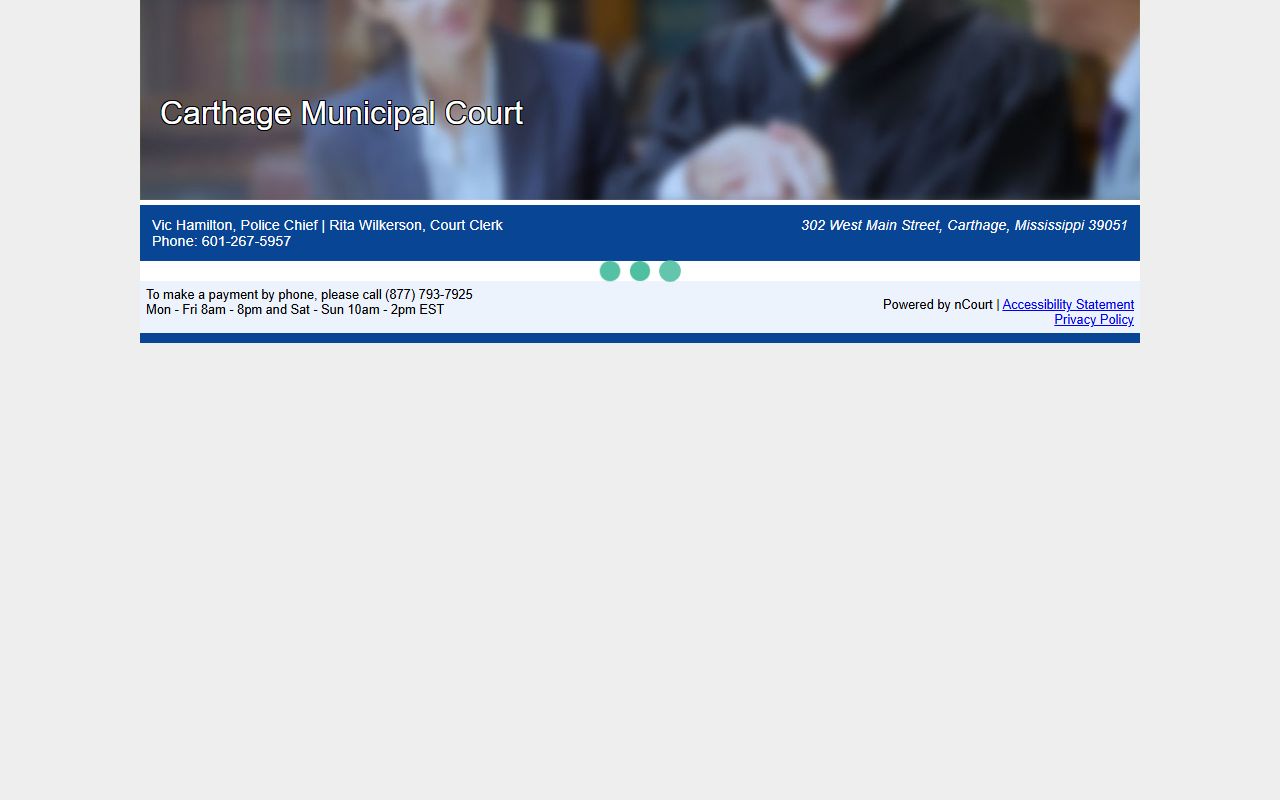
City cases follow a parallel track. The Carthage Municipal Court handles city tickets and ordinance charges, and its online payment portal lists the court address, the police chief, and the court clerk.
City charges and county charges are coded by different bodies of law, so the same conduct can read as a municipal count or a county count depending on where the citation was written. Reading the code on each charge is the quickest way to tell which court controls it.
Leake County Charge Status Terms
Leake County charges rarely stay frozen. As a case moves, a charge can be amended, reduced, added, dropped, or dismissed. The status field on a court record is what tells you where each count stands today. A pending charge is still open. A dismissed charge is closed without a conviction. Reading these terms keeps a search honest, because an old charge listed in a file may have ended very differently from how it started.
| Status | What It Means |
|---|---|
| Pending | The charge is filed and the case is still open, with no final outcome yet. |
| Amended / Reduced | The prosecutor changed the charge, often to a lower level than first filed. |
| Dismissed | The charge was dropped by the court without a conviction. |
| Nolle Prosequi | The prosecutor chose not to pursue the charge, ending it without a verdict. |
Many misdemeanor and traffic charges end when a fine is paid. The Justice Court directs fine payment through its linked MyFinePayment portal, with phone payment also available.
A paid fine usually moves a charge to a closed or satisfied status, while an unpaid one can trigger a failure-to-pay or bench warrant flag in the court file.
Statewide Leake County Charge Lookups
Local charges do not stay purely local. As cases close, charges and outcomes roll up into statewide criminal history and corrections records. The Mississippi Department of Corrections runs a free inmate search for sentenced state inmates and a separate parolee search, both by name or MDOC ID number. These cover people serving state time, not everyone booked into the county jail. Public access to records overall follows the Mississippi Public Records Act, under Miss. Code Ann. § 25-61-1, which favors inspection unless another law restricts it.
Some Leake County arrests lead to federal charges instead of state ones. The county sits in the U.S. District Court for the Southern District of Mississippi, Northern Division, with court held at Jackson. Federal charges are filed by the U.S. Attorney's Office for that district.
Federal cases run on their own docket system and do not appear in the county court index, so a complete charge history sometimes spans both state and federal sources.
Charges vs. Convictions
Being charged is not the same as being convicted. A charge is the accusation a prosecutor files after an arrest. A conviction is the result, reached only by a guilty plea or a verdict. The gap between them matters. Many charges are reduced, dismissed, or dropped, and the person is never convicted at all. Treating a listed charge as proof of guilt is a common and costly mistake when reading any Leake County court record.
| Charge | Conviction | |
|---|---|---|
| Stage | Accusation | Verdict or plea |
| Burden of Proof | Probable cause | Beyond reasonable doubt |
| Who Decides | Prosecutor | Judge or jury |
| Public Record | Yes | Yes |
The full path from charge to outcome, with arraignment, pleas, and sentencing, lives in the Leake County criminal court records file rather than the charge sheet alone.
Background Check Considerations
A casual name search and a formal background check are not the same thing. Reading a public Leake County court file tells you what charges were filed and how they ended. A regulated background check, used for hiring or housing, must follow the federal Fair Credit Reporting Act and stricter accuracy rules. For any decision that affects a job, a lease, or credit, the check has to run through a licensed consumer reporting agency, not a casual lookup.
Important: Leake County Court Records is not a consumer reporting agency under the FCRA, and nothing here may be used for employment, tenant, credit, or insurance screening.
Sealed vs. Expunged Charge Records
Not every charge stays open to the public forever. Mississippi law lets some records be hidden or removed. A sealed record is closed off from ordinary public view but still exists. An expunged record is cleared by court order under Mississippi expunction law, so it is treated as if the charge never happened. Eligibility depends on the charge and the outcome, and the petition is usually filed in the court that handled the case.
- Sealed record
- Hidden from general public access but retained by the court; flagged as sealed in the case index.
- Expunged record
- Removed under Miss. Code Ann. § 99-19-71 and treated as though the charge was never brought.
- Eligibility
- Often open to dismissed charges, acquittals, and certain convictions after a statutory waiting period.
Note: Mississippi expunction can reach dismissed charges, dropped charges, and some convictions, but eligibility is narrow, so confirm the right petition with the clerk or counsel.
Restricted Charge Records in Leake County
Some Leake County charge records are never public. Youth Court charges involving juveniles are confidential under Mississippi law and stay out of the open index. Sealed and expunged charges drop from public view as well. A dismissed charge may be withheld once an expunction order is signed, and records tied to an active investigation can be held back until the matter closes.
Personal identifiers are also screened. Court systems redact items such as Social Security numbers, dates of birth, and account numbers when they appear in filings. The Mississippi Public Records Act allows an office to remove exempt material while still releasing the rest of a record. When a charge does not appear where it should, that absence is often the law working as intended, not a gap in the file.